
I sleep badly in the most enviable possible circumstances. Forest on all sides at the cottage, or a village so quiet you can hear someone three houses down deciding not to start their car. No sirens, no neighbours arguing through a wall, no reason whatsoever. I simply wake up, several times, for no cause I have ever been able to identify, and then lie there being awake at the trees.
So I took a certain grim satisfaction in learning that this is now partly a policy failure. Researchers put sleep trackers on 48,000 people across 68 countries and found that warm nights push us to sleep later and wake earlier, and that by 2010 the average person was already losing something like 44 hours a year to it. On a high-emissions path that climbs toward 58 hours by 2100. Two and a half nights of sleep, annually, gone. Not stolen by anything as dignified as insomnia. Just quietly evaporated, along with the rest of it.
This is a stupid thing to be annoyed about in the summer of 2026, and I know it, which is precisely why I kept clicking. Southern Europe has spent July on fire. France fought its largest wildfire since 1949 and told 84,000 evacuees they could go home. Spain declared a national emergency over blazes near Madrid, the worst since records began in 1961. Three firefighters died on Crete. A new analysis of fire records from 1981 onward found that in parts of France and Spain the hot, dry, windy weather that makes landscapes flammable has intensified by up to fifty percent in the last decade, and that the number of days per summer with strongly fire-promoting conditions has gone from under ten to around twenty-five.
There is no good way to sit with that, so I did the internet thing and went sideways instead, into a rabbit hole about the ocean. Which turns out to be the load-bearing wall of this entire crisis, and which nobody thinks about while watching a hillside burn except as somewhere to fill the helicopter bucket.
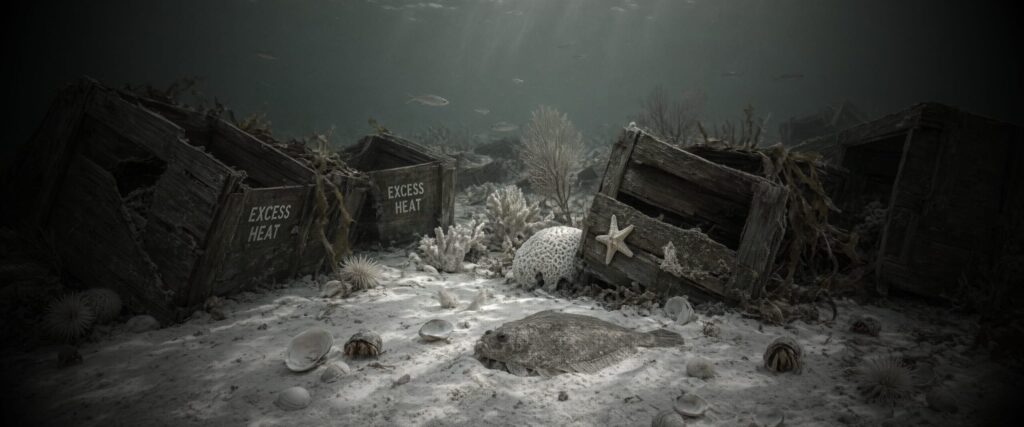
Here is the number that reorganised my afternoon. Roughly ninety percent of the excess heat we have added to this planet has gone into the sea, not the air. Ocean heat content has climbed steadily since measurements began in 1955 and set records in 2023. Every degree of warming you have personally complained about is the ten percent that missed. The other ninety went into the water, silently, without a press release.
It is worth sitting with the implication rather than nodding past it. We have not been getting away with anything. We have been running a tab. The ocean is not solving the problem, it is holding it, and it has been holding it for seventy years with the stoicism of a Finnish man carrying six shopping bags in one trip because two journeys would be an admission of defeat.
The carbon side is odder still. Before industrialisation the ocean was a net source of carbon to the atmosphere. It reversed. It now absorbs roughly a third of what we emit, not because it volunteered but because we changed the chemistry of the air enough to force the transfer. There is no version of this where the sea agreed to anything.
The bill arrives in the form of pH. Dissolved carbon dioxide becomes carbonic acid, and average seawater pH has slid from about 8.2 to 8.1. That looks like a rounding error and is not, because pH is logarithmic, which is the sort of detail that separates a comforting number from a genuinely alarming one. Meanwhile the IPCC’s estimate is that 70 to 90 percent of tropical coral reefs go if warming hits 1.5°C, and reefs shelter something close to a third of known marine species while occupying well under a fifth of one percent of the ocean.
Some of the adaptations are almost funny, in the way that things are funny at two in the morning. Clownfish on reefs in Papua New Guinea have been observed shrinking their own bodies by one or two percent under heat stress, and it works. Their survival odds improve dramatically. A fish three inches long has independently arrived at a coping strategy more disciplined than anything I have managed, and it did not need an app to do it.
And for all of this, the ocean got exactly one mention in the roughly 7,300 words of the Paris Agreement. One. The system absorbing ninety percent of the heat and a third of the carbon received about as much text as a subclause on reporting timelines. The explanation offered by people who work on this is unglamorous and entirely believable, which is that most climate policymakers were trained on land and think in terms of land.
None of which puts out a single fire in the Gironde, and none of which is going to get me through the night. But it did adjust what I am looking at when the footage comes on. The fire is the part that is legible. The part that matters more is flat and blue and covers seventy percent of the planet and has been absorbing the consequences of the last century so efficiently that we have been able to argue about whether the consequences exist.
It is doing us an enormous favour. Favours of this size are generally not free, and this one is on a payment plan we did not read.
Sources
- Live Science, “15 unexpected effects of climate change” (summarising the sleep study published in One Earth, May 2022) — https://www.livescience.com/planet-earth/climate-change/unexpected-effects-of-climate-change
- Al Jazeera, “Europe’s heating climate sparks ‘major intensification’ of fires: Report” (30 July 2026) — https://www.aljazeera.com/news/2026/7/30/europes-heating-climate-sparks-major-intensification-of-fires-report
- Al Jazeera, “Wildfires in southwest Europe: What we know so far” (27 July 2026) — https://www.aljazeera.com/news/2026/7/27/wildfires-in-southwest-europe-what-we-know-so-far
- Euronews, “Three ways Southern Europe can reduce its ‘intensifying’ wildfire risk” (30 July 2026, covering the study in Scientific Reports) — https://www.euronews.com/2026/07/30/southern-europe-is-dealing-with-fewer-blazes-but-greater-wildfire-risk-is-there-a-solution
- NASA Science, “The Ocean and Climate Change” — https://science.nasa.gov/earth/explore/the-ocean-and-climate-change/
- Earth.Org, “11 Interesting Climate Change Facts” — https://earth.org/data_visualization/11-interesting-facts-about-climate-change/
- IFAW, “How climate change impacts the ocean” (ocean acidification and reef projections) — https://www.ifaw.org/international/journal/climate-change-impact-ocean
- Earth Day, “Holy Ship! 11 Absolutely Bonkers Ocean Facts” (clownfish heat-stress shrinking) — https://www.earthday.org/holy-ship-11-absolutely-bonkers-ocean-facts/
- UN Foundation, “5 Things to Know About Climate Change and the Ocean” (Paris Agreement text, policy framing) — https://unfoundation.org/blog/post/5-things-to-know-about-climate-change-and-the-ocean/