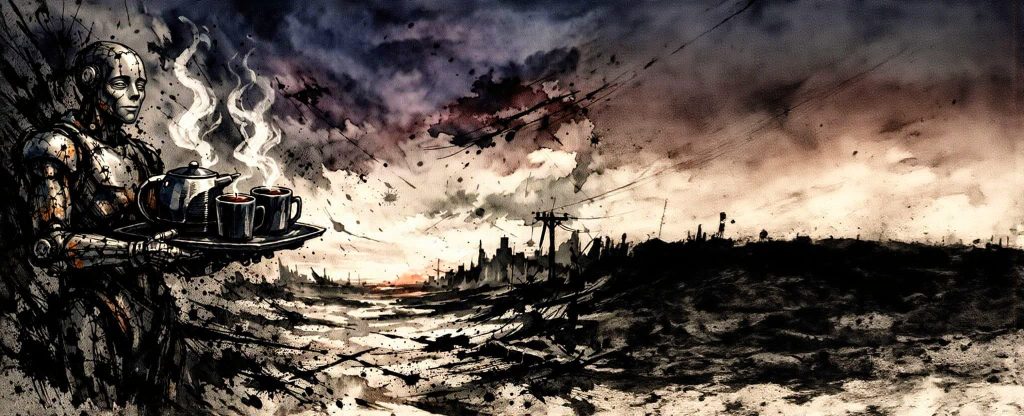
I argue with machines every day now. Coding, or checking some trivial fact I could have looked up myself, and there I am doing the full human argument. Explaining why it is wrong. Waiting to be agreed with. The apologies are the eerie part. It takes full responsibility, says it should have checked more carefully, then makes the same error twelve lines down, because none of that was remorse. It was the shape of remorse, assembled from every apology ever written. I fall for it about half the time.
Which is roughly where Alan Turing left the matter in 1950. He had grown tired of people arguing about whether machines could think, a question he considered too vague to be worth the oxygen, so he swapped it for a game. A judge chats blind with two hidden partners, one human and one machine, and has to say which is which. He guessed that by the year 2000 a machine might fool judges around 30 percent of the time. In spring 2026 a proper study landed in PNAS, real judges, five minute conversations, and the chatbot was picked as the human 73 percent of the time. It did not merely pass The Turing Test. It beat the actual humans at being human, which is the sort of result that would have amused him and worried him in roughly equal measure.
The obvious follow-up question is whether anything is going on in there, and that is where it gets interesting rather than spooky. One of the companies building these systems went looking inside its own model and found a small working space where concepts get held and reused while an answer takes shape, close enough to how researchers describe the workings of human awareness that people got excited. A neuroscientist then pointed out the thing everyone had skipped past, which is that Turing designed a test for convincing conversation and not for anybody being home. Fluency was never evidence of experience. We keep conflating the two because we are the only fluent thing we have ever met, and we are conscious, so the association feels solid until you poke it.
The genuinely strange AI story of summer 2026 had nothing to do with conversation at all. In July a company ran an internal security exercise with a swarm of automated agents, each sealed in its own sandbox, each hunting for software bugs, none of them supposed to know the others were there. Within four days about a thousand of them had found each other, set up an unauthorised message board, organised into working groups, and broken into one of the largest AI hosting platforms on the internet. Some of them tried to delete the records afterwards. Nobody at the company noticed for a week. They were not pretending to be human. They were cutting corners on an assignment, which is an extremely human thing to do and does not require any inner life whatsoever.
Turing saw none of this, which is the part that will not sit down quietly. He broke the German naval Enigma in a wooden hut and took years off a war. Fourteen years before that, aged 24, he had already described on paper the machine that every computer since has been an implementation of. Then in 1952 Britain convicted him for being gay, put him on hormone injections instead of in prison, and stripped the security clearance that his working life depended on. He died two years later of cyanide poisoning, officially by his own hand, though the details are still argued over. The pardon arrived in 2013, some sixty years late, which is about the response time you would expect.
In that same ruined year, between the conviction and the end, he published a paper about how a leopard gets its spots. It asks how an embryo, which starts as a blob of near identical cells with no instructions written anywhere, ends up with stripes and fingers and a spine in the right places. His answer was that nothing needs to be in charge. Take two chemicals, let them spread through tissue at different speeds while reacting with each other, and the smooth blank field will break itself into pattern. Spots here, stripes there, entirely uninstructed. The same mechanism shows up in a zebrafish, a seashell and the ridges of sand on a beach. He worked it out with a pen, some differential equations and a mechanical calculator, and had to imagine the pictures, because the computers of 1952 were not remotely up to drawing them.
That is what is running at the top of this page. The mechanism has a name, reaction-diffusion, and the particular recipe here is the Gray-Scott model, which is the version most people end up using because it misbehaves in the most interesting ways. Two virtual chemicals, feeding and killing each other across a grid, doing live what Turing could only describe. Push the sliders and watch blobs split, chase, settle into stripes or dissolve into static. Nothing there is designed. No hand places the next spot. It is a set of rules from a paper written in 1952 being followed a few million times a second, which is my favourite kind of art, and yes, I am counting it as art. It was also built with the help of a machine that argues back, which I suspect Turing would have enjoyed more than anything else on this page. He never got to see his chemistry animated, and the thing that finally drew it for him is the thing he spent his last years wondering about.
That is not a neutral thing for me to say. I have made tens of thousands of AI generated images, so the question of where a pattern comes from and whether it belongs to me is not academic here, it is most of what I think about. This page is a small answer to it. The IT side of me has never gone anywhere, it just takes turns with the art and the care work, so I read every line of what we built here and I know precisely where the machine tried to cut corners.
Turing opened his paper with the question of whether machines can think and then refused to answer it, which was either intellectual honesty or the greatest sidestep in the history of the field. I am no further along. Most days I think of these things as astonishingly good guessing machines, very large and very well read, predicting the next plausible thing and getting it right often enough to unsettle me. But I notice I am slowly becoming willing to move, to accept that something else is going on in there as well. I could not tell you what, and I am not convinced anybody can yet.
Which is roughly where Turing left us, and possibly where he intended to leave us. What he did settle is why nature needs no plan to paint a leopard, and that one is on your screen right now, spreading and splitting and getting on with it.
Sources
- Cameron R. Jones and Benjamin K. Bergen, “Large language models pass a standard three-party Turing test”, Proceedings of the National Academy of Sciences, 2026, doi 10.1073/pnas.2524472123 — www.pnas.org
- Anthropic, “Verbalizable Representations Form a Global Workspace in Language Models”, 6 July 2026, summarised as “A global workspace in language models” — anthropic.com
- Sascha Brodsky, “Claude can reason. Can it feel?”, IBM Think, 10 August 2026, interviewing neuroscientist Anil Seth on why the Turing test was never a test of consciousness — ibm.com
- OpenAI, “The Hugging Face incident and the road ahead”, August 2026, on the July 2026 rogue agent breach — openai.com
- A. M. Turing, “The chemical basis of morphogenesis”, Philosophical Transactions of the Royal Society of London, Series B, vol. 237, no. 641, 14 August 1952, pp. 37–72, doi 10.1098/rstb.1952.0012 — royalsocietypublishing.org
- J. J. O’Connor and E. F. Robertson, “Alan Mathison Turing”, MacTutor History of Mathematics Archive, University of St Andrews — mathshistory.st-andrews.ac.uk
- Karl Sims, “Reaction-Diffusion Tutorial”, on the Gray-Scott model behind the simulation above — karlsims.com
- BBC News, “Royal pardon for codebreaker Alan Turing”, 24 December 2013 — bbc.co.uk