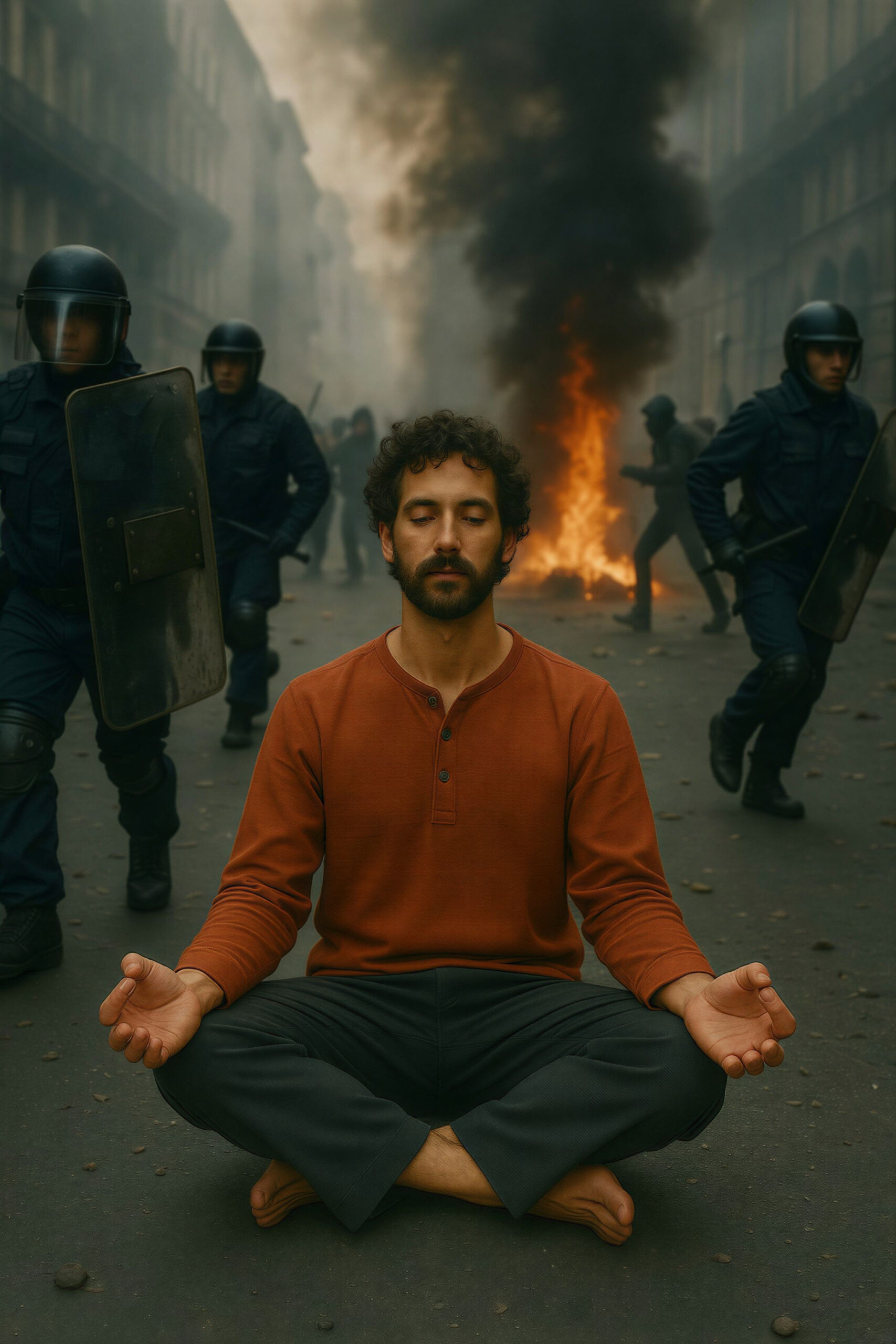
I meditate lying down, early in the morning, in bed, before the alarm clock gets a say. Some traditions would rather I sat upright, and they have their reasons, but horizontal works for me. As far as I can tell the one rule that really matters is that you do it at all.
I usually wake before the alarm anyway, and I’ve learned to use that stretch of time well. I don’t jump up, and I don’t start rehearsing the day’s worries in order of urgency. I lie still and try to empty my head. For a few minutes I want to be someone with nothing pending, a warm shape under a duvet that happens to be breathing.
This is harder than it sounds, because my waking mind is loud. It houses a whole troupe of monkeys, each one yelling a different idea, memory or opinion nobody asked for. Getting them to sit down is the entire project. On the mornings it works, what’s left is a quiet with room in it, and I carry some of that room into the day.

What meditation actually is
At its simplest, meditation is the practice of directing attention. You can do it lying down, sitting cross‑legged, washing dishes with the radio off or walking slowly through a forest. No posture is compulsory, no tradition requires a membership, and no app needs a subscription. You decide where your attention goes, and when it drifts off somewhere else you notice and bring it back, as many times as it takes.
Walking in the forest is my other regular practice besides the horizontal morning session. In Finland this is easy to arrange, since a forest is rarely far away. I walk slowly, with no destination and no step count, and let my attention rest on whatever the forest offers. Sounds, smells, the ground under my feet. The monkeys come along for the first stretch, but out there they seem to run out of steam sooner than they do in the bedroom.
Research backs up the feeling, though the results are more nuanced than the headlines. In a Helsinki field study led by Liisa Tyrväinen, 77 people spent time in the city centre, in a park and in an urban forest. Both green places felt clearly more restorative than the city, the forest slightly more so, and time in the city centre actually reduced positive feelings. The stress hormone CortisolCortisol is a steroid hormone made by the adrenal glands. Its level follows a daily rhythm, peaking in the morning, and rises in response to stress, which is why stress researchers measure it so often.Read more on Wikipedia →, on the other hand, dropped just as much in all three places. Apparently the body was mostly pleased to be out of the office. In Japan the forest version has its own name, Shinrin‑yokuShinrin‑yoku is Japanese for forest bathing. It means spending unhurried time in a forest and taking it in through all the senses, as a form of relaxation that has been studied as a way to ease stress.Read more on Wikipedia →, usually translated as forest bathing.
What meditation is for depends on who you ask. In Buddhist tradition the original aim is liberation from suffering and delusion, which is a tall order. The secular Western version most of us know sets its sights lower. Less stress, better focus and a steadier mood.
What the science says, and what it doesn’t
The most studied programme is Mindfulness‑Based Stress Reduction (MBSR)MBSR is an eight‑week course developed in the late 1970s by Jon Kabat‑Zinn at the University of Massachusetts Medical School. It combines mindfulness meditation, body awareness and yoga to help people manage stress, pain and illness.Read more on Wikipedia →, developed by Jon Kabat‑ZinnJon Kabat‑Zinn (born 1944) is an American professor emeritus of medicine at the University of Massachusetts Medical School. In 1979 he founded the Stress Reduction Clinic there, where MBSR began.Read more on Wikipedia → in 1979. A large 2014 meta‑analysis in JAMA Internal Medicine found moderate evidence that meditation programmes ease anxiety, depression and pain. In a 2022 trial an eight‑week mindfulness course helped with anxiety about as much as a commonly prescribed antidepressant. The effects are modest, but they show up again and again.
Brain imaging has found structural differences in long‑term meditators, for example slightly thicker areas of the Prefrontal cortexThe prefrontal cortex is the frontmost part of the brain's frontal lobes. It is involved in planning, decision making, attention and keeping impulses in check.Read more on Wikipedia →, which is involved in attention and self‑regulation. Sara Lazar’s 2005 study is the one most often cited. These studies are usually small, and people who choose to meditate for years may differ from others to begin with, so the findings are intriguing but not conclusive.
The AmygdalaThe amygdala is a pair of almond‑shaped clusters of neurons deep inside the brain's temporal lobes. It plays a central part in processing emotions, fear in particular, and in setting off the stress response.Read more on Wikipedia →, the part of the brain that sets off the stress response, seems to react less strongly after regular practice. That fits what meditators themselves describe, but proving cause and effect is another matter.
The research has its weak spots. Much of it relies on small samples and poor control groups, and positive results get published more readily than negative ones. Willoughby Britton’s team at Brown University has also documented that meditation doesn’t agree with everyone. For some people, intensive practice brings on anxiety, dissociation or other difficult experiences.
All in all, meditation probably does most people some good, especially for stress and attention, and the effects grow clearer with regular practice. It isn’t a cure, and it’s wise to be wary of anyone who promises one.
Breathing as a tool, or a way in
Breathing exercises are a separate thing, although the two often go together. You can benefit from conscious breathing without meditating, and you can meditate without paying any special attention to your breath. Breath is still a handy anchor, because it runs on autopilot until you decide to steer it, and then it lets you.
When I reach that morning quiet, my breathing slows and deepens on its own without any effort from me. The mind settles first and the breath follows. Plenty of people find the opposite order easier, starting with the breath and letting the mind catch up.
I learned the classic techniques at a yoga class as a young man, some 35 years ago. The most common advice is to breathe in through the nose and out through the mouth, and the first half has solid physiology behind it. The nose filters, warms and humidifies the air, and the sinuses release a small amount of Nitric oxideNitric oxide is a colourless gas that the body also uses as a signalling molecule, for example to widen blood vessels. The sinuses produce it continuously, and air breathed in through the nose carries it down to the lungs.Read more on Wikipedia → that travels down with each breath. Swedish researchers showed in the 1990s that this nasal nitric oxide slightly improves how well the lungs take up oxygen. Breathing out through the mouth makes a long, slow exhale easier to control. Pursed‑lip breathing takes this further, with the exhale going gently out through lips shaped as if to blow out a candle. It slows the breath right down and is used in rehabilitation for people with Chronic obstructive pulmonary disease (COPD)COPD is a long‑term lung disease in which the airways narrow and air has trouble getting out of the lungs, causing breathlessness and cough. Tobacco smoking is the most common cause.Read more on Wikipedia →, because it helps keep the airways open during the exhale. Yoga has its own variations, such as UjjayiUjjayi, Sanskrit for victorious, is a yogic breathing technique. Both the in‑breath and the out‑breath go through the nose, and a slight narrowing at the back of the throat makes a soft whispering sound. It is often practised together with yoga postures.Read more on Wikipedia →, where both the in‑breath and the out‑breath go through the nose with a soft, whispering sound at the back of the throat.
I’ll admit I follow all of this only now and then. Most mornings I let the breath go its own way. On restless days, though, a few deliberate rounds help.
A longer exhale than inhale activates the Parasympathetic nervous systemThe parasympathetic nervous system is the part of the autonomic nervous system that calms the body. It slows the heart and supports digestion, and is often called the rest and digest system, the counterpart of fight or flight.Read more on Wikipedia →, which calms the body, and the heart rate dips a little on every out‑breath. The 4‑6 rhythm, four seconds in and six out, is built on exactly this. Coherent breathing slows things to five seconds each way, about five breaths a minute, and slow breathing of this kind has been studied in relation to anxiety and Heart rate variabilityHeart rate variability is the natural variation in the time between one heartbeat and the next. Higher variability at rest is generally linked with good health and an active parasympathetic nervous system.Read more on Wikipedia →. Box breathing gives each step four counts, in, hold, out and hold, and people like it because it works quickly and needs no equipment. The 4‑7‑8 technique adds a long hold before a slow exhale. The first few rounds of that seven‑second hold can feel long.
On their own, these techniques aren’t meditation. They’re practical tools, and what you do with the calm they bring is up to you.
I made a small breathing mandala to go with this post. It opens as you breathe in and closes as you breathe out, and its shape and colours change a little with every cycle. Whether it helps you or is simply nice to look at is for you to decide. The monkeys have not yet delivered their verdict.
Further reading
- r/Meditation FAQ, Reddit is a friendly community guide to getting started, with an overview of the main types of meditation and honest answers to common beginner problems.
- Getting Started with Mindfulness, Mindful.org is a clear, non‑dogmatic introduction to meditation.
- Meditation techniques for stress, sleep and focus, Harvard Health looks at different ways to meditate.
- Meditation Programs for Psychological Stress and Well-being, JAMA Internal Medicine 2014 is the big meta‑analysis.
- Can mindfulness help anxiety? Trial suggests yes, Harvard Gazette covers the trial that compared mindfulness with medication.
- The Varieties of Contemplative Experience, Britton lab at Brown University is about meditation’s difficult side.
- The influence of urban green environments on stress relief measures, Tyrväinen et al. 2014 is the Finnish field study on forests, parks and stress.
- How Breath-Control Can Change Your Life, Frontiers in Human Neuroscience 2018 is a systematic review of slow breathing.
- Inhalation of nasally derived nitric oxide modulates pulmonary function in humans, Lundberg et al. 1996 is the original nasal nitric oxide study.
- Pursed-Lip Breathing, Cleveland Clinic explains the technique and why it works.
- Breathing Exercises, Three To Try, Dr. Andrew Weil describes 4‑7‑8 from its originator.
The terms explained in the text, on Wikipedia
- Cortisol
- Shinrin‑yoku
- Mindfulness‑Based Stress Reduction (MBSR)
- Jon Kabat‑Zinn
- Prefrontal cortex
- Amygdala
- Nitric oxide
- Chronic obstructive pulmonary disease (COPD)
- Ujjayi
- Parasympathetic nervous system
- Heart rate variability