If you come from a country where “private property” is a sacred religion enforced by high fences and dogs with boundary issues, Finland’s jokamiehenoikeudet (Everyman’s Rights) will feel like a glitch in the Matrix. It is the radical, almost anarchic notion that the land belongs to everyone and no one at the same time. You can wander, sleep, and forage on a stranger’s land without asking for a permit, paying a fee, or even saying hello. In fact, in Finland, not saying hello is usually preferred.
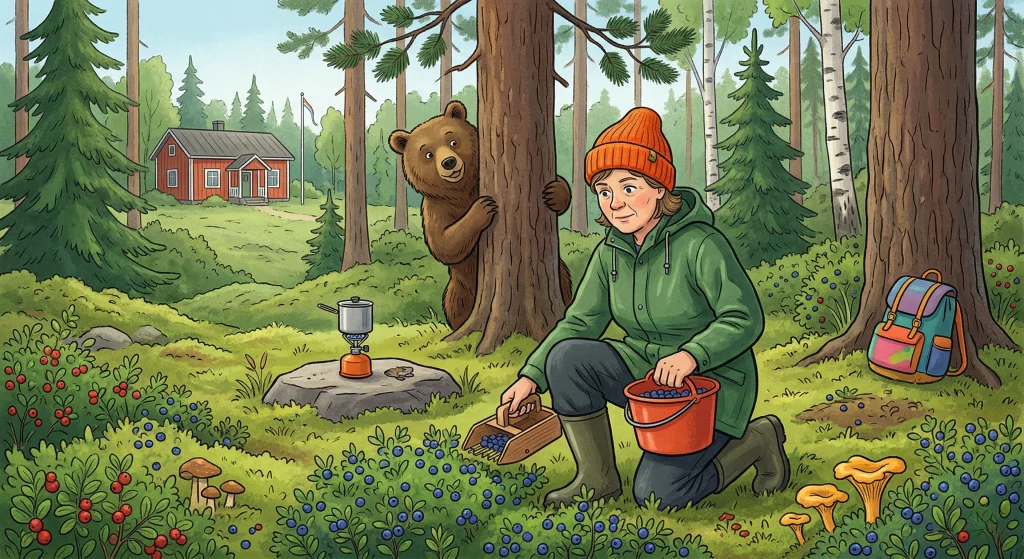
This isn’t just about the “spiritual connection to nature” that travel brochures love to drone on about. There’s a very practical, almost mercenary side to this freedom. In a nation where the taxman usually wants a piece of everything — from your salary to your Saturday night beer — the forest remains a glorious, mossy tax haven. Any individual can pick wild berries or mushrooms and sell them entirely tax-free. It is effectively a government-sanctioned ATM made of pine needles and blueberries. You can walk into a forest that you don’t own, fill a bucket with “forest gold,” sell it at the local market, and the tax office won’t take a single cent. It’s a beautiful anomaly in a world that usually demands a receipt for your breath.
However, this radical freedom has hit a very modern, very complicated snag. What was once a quaint tradition of a grandmother picking lingonberries for her winter jam has turned into a massive industrial operation. Every summer, thousands of professional pickers are flown in from abroad to harvest berries on a commercial scale. This has sparked a tension that the “Everyman’s Rights” were never really designed to handle. When a professional crew strips a local’s favorite chanterelle patch bare before sunrise, the “radical equality” of the woods starts to feel a lot like a global supply chain problem. It’s a sensitive topic in rural Finland, raising uncomfortable questions about whether these ancient rights were meant for personal sustenance or international profit.
To survive this system without getting a stern Finnish stare—or worse, a polite but firm letter—you have to follow the unwritten social contract of the “invisible guest.” The rule of thumb is to stay roughly 300 meters away from any dwelling. If you are close enough to hear a local’s radio or smell their coffee, you have officially invaded their fortress of solitude. The right to roam is not a right to participate in someone else’s garden party. You move like a ghost, you pick your berries, and you leave the landowner’s peace completely undisturbed.
And then there is the fire. For some reason, visitors often confuse “freedom to roam” with “freedom to play with matches.” It is worth stating clearly: you cannot just build a campfire wherever you feel like it. Making an open fire is one of the few things strictly forbidden without the landowner’s explicit permission, unless you are at a designated, official campfire site. Finland is essentially one giant, slow-growing pile of timber, and the radical freedom to enjoy the woods does not include the right to accidentally incinerate them.
Ultimately, Everyman’s Rights are a test of collective maturity. It’s a system that refuses to slice the world into restricted zones, but it only works if everyone agrees to be remarkably boring and respectful. It is the freedom to be part of the landscape rather than its owner—a quiet, powerful rebellion against the idea that everything on this earth must have a price tag and a fence.
Further reading:
Selling wild berries and mushrooms is tax-exempt
The Official Guide to Everyman’s Rights
Recreational Use of Nature and Legal Framework