You’ve seen those posts. The sun will eventually expand and swallow the Earth. There are more trees on Earth than stars in the Milky Way. A day on Venus is longer than a year on Venus. Good stuff. But one I almost never see mentioned is oxygen.
Oxygen is not a background feature of the universe. It’s not sitting around waiting to be breathed. The oxygen in Earth’s atmosphere exists almost entirely because of life, and without life continuously replenishing it, it would eventually vanish.
Oxygen is something schools tend to gloss over. It’s reactive. Unlike nitrogen, which makes up most of our air and is famously inert, oxygen wants to combine with things. It bonds with rocks. It bonds with volcanic gases. It bonds with organic material on the ground and produces carbon dioxide, rust, and fire. Every time something burns, every time iron oxidizes, every time lava hits the air, oxygen gets consumed. It doesn’t vanish, but it leaves the atmosphere.
If photosynthesis stopped today, this slow drain would continue. Over geological time, the free oxygen in our atmosphere would steadily decline, used up in chemical reactions the way a candle uses air in a sealed jar. The jar gets bigger, the candle burns lower, but the ending is the same.
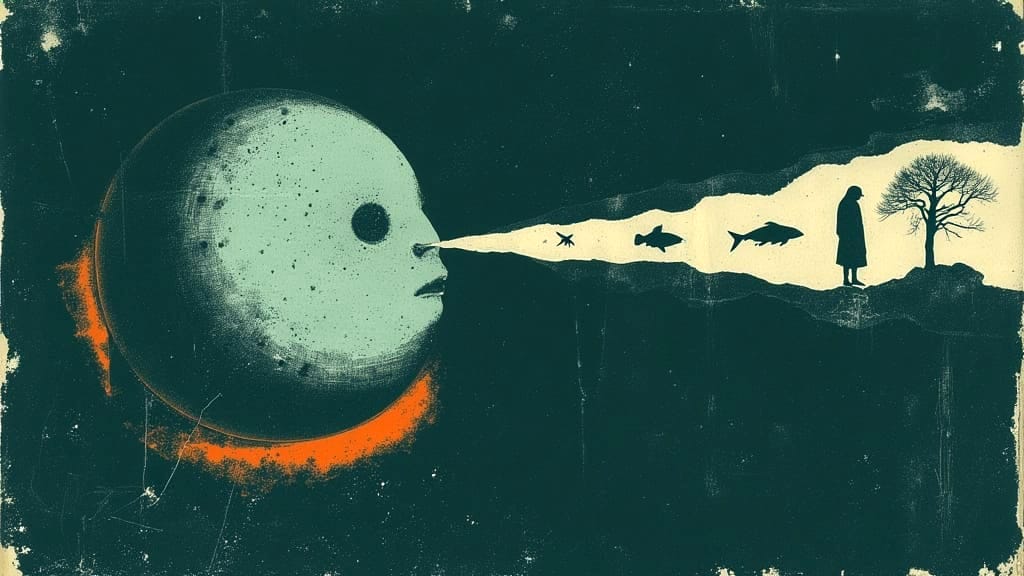
Before life figured out photosynthesis, Earth’s atmosphere had almost no free oxygen at all. What we breathe today is, chemically speaking, industrial pollution. The oxygen economy we depend on was set in motion roughly 2.4 to 2.3 billion years ago, when cyanobacteria evolved the ability to split water molecules using sunlight. Oxygen was a byproduct of that process. A waste gas. It accumulated in the oceans and eventually, when the geological sinks were saturated, it began building up in the atmosphere.
The result was not great, if you were the existing life. The event now known as the Great Oxygenation Event is believed to have triggered the first mass extinction in Earth’s history. Most organisms at the time were anaerobic, meaning they’d done perfectly well without free oxygen and found it actively toxic. They died in enormous numbers as this strange new gas accumulated. The cyanobacteria, blissfully photosynthesising away, had no idea. They were just eating sunlight and exhaling waste, the way you do.
There’s an analogy here that I’ll leave mostly unspoken, except to note that the cyanobacteria didn’t know what they were doing, couldn’t have stopped if they had, and the life that eventually inherited the planet was the stuff that figured out how to breathe their pollution. So there’s your optimistic reading, if you want one.
As a bonus, the oxygen also built us a roof. When UV radiation hits oxygen molecules high in the atmosphere, they split apart and recombine as ozone. The entire ozone layer is a byproduct of biological oxygen production. Take away the life, you lose the oxygen, you lose the ozone, and now you have a planet surface getting steadily cooked by radiation that shreds DNA. Worse than a bit more sunburn. Considerably worse.

This is also why oxygen gets astronomers excited when they think about searching for life on other planets. A world with a stable, oxygen-rich atmosphere is chemically strange. Oxygen is reactive. It wants to bond with things and leave the atmosphere. A planet that keeps it around in quantity is almost certainly doing so because something is continuously producing it. Detect free oxygen alongside gases it shouldn’t chemically coexist with, and you have a planet quietly waving a flag.
NASA’s astrobiology programme has spent real effort trying to work out how to tell biological oxygen from the rarer abiotic processes that can also produce it, because getting that wrong in either direction would be unfortunate.
So the next time someone posts one of those space facts, you have one to add. Every breath you take is a small transaction in a two-and-a-half-billion-year biological economy run by organisms that never meant to help you. The ozone layer protecting your skin exists for the same reason. And if we ever spot a distant planet wrapped in the same suspicious chemistry, the most interesting explanation will be that something out there is doing what life does: eating, exhaling, and not thinking about the consequences.
Sources
- ScienceDirect Topics, Great Oxygenation Event — overview of the GOE timeline, oxygen toxicity, and the atmospheric transition. https://www.sciencedirect.com/topics/agricultural-and-biological-sciences/great-oxygenation-event
- Imperial College London, Imperial scientist explains how oxygen triggered Earth’s first mass extinction (2016). https://www.imperial.ac.uk/news/171487/imperial-scientist-explains-oxygen-triggered-earths/
- Slate, The Great Oxygenation Event: The Earth’s first mass extinction (2014). https://slate.com/technology/2014/07/the-great-oxygenation-event-the-earths-first-mass-extinction.html
- Meadows et al., Exoplanet Biosignatures: Understanding Oxygen as a Biosignature in the Context of Its Environment, Astrobiology 18 (2018), pp. 630–662. Peer-reviewed. The biosignature section is the primary source for the oxygen-as-planetary-flag discussion. https://journals.sagepub.com/doi/full/10.1089/ast.2017.1727
- NASA Astrobiology Programme (new home), science.nasa.gov/astrobiology — general reference for ongoing biosignature and exoplanet habitability research. https://science.nasa.gov/astrobiology/