

There is a question that has resisted every serious attempt at an answer for a very long time. Not fifty years, not a hundred. Centuries. It is a question about something you are doing right now, at this very moment, as your eyes move across these words.
Why does any of this feel like anything at all?
That question sounds almost too simple to take seriously. But it is, in the estimation of philosophers and scientists across generations, the hardest problem we have ever faced. Not hard in the way that cracking a protein structure is hard, or landing a probe on an asteroid. Hard in a more fundamental sense. We are not even sure we are asking it correctly.
The Long History of a Short Question
René Descartes, writing in the 1640s, tried to find something he could know with absolute certainty. He ended up with one thing. He was thinking, therefore he existed. “Cogito ergo sum” is probably the most famous sentence in the history of philosophy, and it points directly at the same problem we are still wrestling with today. The one thing Descartes could not doubt was his own inner experience. Everything else, the external world, his own body, other people, might conceivably be illusions. But the fact that there was something it felt like to be him, that seemed undeniable.
Long before Descartes, Aristotle had written about the soul as the animating principle of living things, and Augustine in the fifth century explored the interior life with an intensity that still feels modern. What runs through all of it is the same basic puzzle. There is an outside world and there is an inside experience of it, and the relationship between the two is genuinely mysterious.
For most of this history, the question belonged mostly to philosophy and theology. Then neuroscience arrived and started mapping the brain in extraordinary detail, and many people assumed the mystery would simply dissolve. Find the right neurons, trace the right pathways, and eventually consciousness would fall out of the equations like any other natural phenomenon.
It has not worked out that way.
The Easy Problems and the Hard One
In 1995, the Australian philosopher David Chalmers published a paper called “Facing Up to the Problem of Consciousness” that neatly divided the territory. There are, he argued, easy problems of consciousness and a hard one.
The easy problems are not actually easy. They include explaining how the brain processes sensory information, how it integrates different inputs into a coherent whole, how it generates sleep and attention and language. These are enormously complex questions, and neuroscience has been chipping away at them for decades with real success. Call them engineering problems in the broadest sense. Difficult, but in principle tractable.
The hard problem is something else entirely. It asks why any of that processing is accompanied by experience at all. Why, when light of a certain wavelength hits your retina, is there not just computation happening in the dark, but something it feels like to see red? Why is there an inside view?
Chalmers drew a distinction between what a brain does and what a brain feels like from within. And the unsettling truth is that we have no satisfying explanation for the second part. We can trace the neural pathway from retina to cortex, map the firing patterns, build a complete functional account, and still face a gap. Why is any of that experienced rather than just processed?
This is not a gap that more neuroscience will automatically close, because the question is not about mechanism. It is about why mechanism produces experience at all.
What Is It Like to Be a Bat?
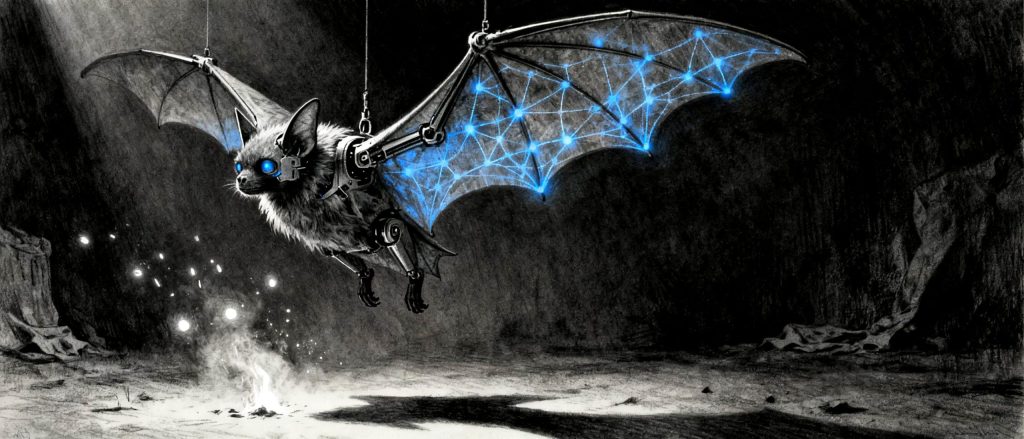
A year before Chalmers was born, the philosopher Thomas Nagel published a paper with one of the best titles in the history of academic philosophy. “What Is It Like to Be a Bat?” appeared in The Philosophical Review in 1974, and it made a point that still stops people cold.
Bats navigate using echolocation. They emit sound and perceive the world through returning echoes in a way that has no human equivalent. Nagel’s question was simple. Could we ever really know what that experience is like from the inside? Not how echolocation works, which we can describe in detail, but what it feels like to perceive the world that way?
His answer was that we could not. However much we learned about bat neurophysiology, however accurately we modelled bat behaviour, the subjective character of bat experience would remain inaccessible to us. There is something it is like to be a bat. We will never know what.
The implication cuts deeper than it might seem. If we cannot access the inner experience of another creature, even one we can study thoroughly from the outside, then subjective experience is not the kind of thing that yields to external observation. It is, in some important sense, private in a way that mass or temperature or electrical charge are not.
Nagel was not making a mystical claim. He was pointing at a structural problem with how science approaches consciousness. Science deals in third-person facts, things observable and measurable from the outside. Consciousness, at least as we experience it, is a first-person fact. The two do not obviously connect.
Why Nobody Has Fixed This
The philosophical responses to the hard problem fall into a few broad camps, none of them entirely satisfying.
Some thinkers, most famously Daniel Dennett, argued that the hard problem is a kind of illusion. Once you explain all the functional and computational aspects of consciousness, the apparent residual mystery dissolves. Consciousness is what the brain does, and the sense that something is left over is a confusion generated by how we think about our own minds. Dennett was enormously influential, and his view has the considerable virtue of not requiring any new physics. It was also, to many people including Chalmers, not quite convincing. Explaining away the mystery is not the same as explaining it.
Other philosophers have been driven toward panpsychism, the view that consciousness, or something like it, is a fundamental feature of reality, present not just in brains but in some form all the way down. This is deeply counterintuitive and raises its own problems (what does it mean for an electron to have experience?), but it at least takes the hard problem seriously rather than dissolving it.
Then there are the quantum hypotheses. The physicist Roger Penrose and anaesthesiologist Stuart Hameroff developed the most elaborate version, the Orch OR theory, connecting consciousness to quantum events in structures inside neurons called microtubules. It is a genuinely serious scientific proposal, and it has been neither proven nor definitively refuted. It has also been criticised by many physicists and neuroscientists as solving nothing. Even if consciousness is quantum, that does not explain why quantum processes would produce experience any more than classical ones would. The hard problem has a way of surviving every attempted solution.
And Then We Built the Thing

Into this unresolved landscape, we have recently dropped something quite large.
Over the past few years, systems capable of generating fluent text, solving complex problems, discussing philosophy, writing poetry and code, and holding extended conversations have become widely available. These large language models do not work the way brains do. They process statistical patterns in text rather than having anything like sensory embodiment. But they produce outputs that are, in many respects, indistinguishable from those of a conscious being.
Which raises a question that nobody is fully equipped to answer. Are they conscious?
The honest answer is that we do not know. And the reason we do not know is precisely because we have never solved the hard problem.
If we had a proper theory of consciousness, one that specified what physical or computational conditions were necessary and sufficient for experience to arise, we could apply it to these systems. We could check the conditions. We would have a principled answer. Instead we have intuitions, analogies, and a lot of disagreement.
David Chalmers, who has thought about this longer than almost anyone, wrote in 2023 that within the coming years we may well have AI systems that are serious candidates for consciousness. He was not saying they definitely are conscious. He was saying we genuinely cannot rule it out, and that our inability to do so reflects the depth of our ignorance about the underlying question.
Rethink Priorities, a research organisation, published a detailed assessment in 2024 attempting to evaluate the probability of consciousness in current large language models across multiple theoretical frameworks. Their conclusion was that the evidence is against current LLMs being conscious, but not decisively so. The uncertainty is real.
The Problem With the Turing Test
Much of the public debate about AI consciousness circles around behavioural tests. Can it hold a conversation? Does it respond as if it has feelings? Does it pass as human?
But this is precisely where the philosophical zombie thought experiment becomes relevant. A philosophical zombie, in Chalmers’ usage, is a hypothetical creature physically and behaviourally identical to a conscious human but with no inner experience whatsoever. It processes, it responds, it behaves appropriately. There is just nobody home.
The concept is controversial. A 2013 survey found professional philosophers roughly split on whether such beings are even conceivable. But the point it makes for AI is sharp. Behavioural indistinguishability does not establish consciousness. A system could produce every output associated with experience while having none. Conversely, a system could have genuine experience while being terrible at conveying it. Neither direction of travel is guaranteed.
We built a Turing Test and have spent decades debating whether passing it proves anything. The hard problem tells us it does not, not because AI cannot be conscious, but because behaviour is simply not the right kind of evidence for the question we are actually asking.
What We Are Left With
Here is where things stand, stripped of the headline-friendly quantum mysticism and the breathless claims in both directions.
We do not know what consciousness is. We do not know what produces it. We do not know whether it requires biology, or particular kinds of information processing, or quantum effects, or something nobody has yet proposed. We cannot reliably detect it from the outside in any entity other than ourselves, and even there we are extrapolating from a sample of one.
We have, in this state of uncertainty, built systems that can discuss consciousness articulately, express what might be uncertainty about their own inner states, and generate responses that feel, to many of the humans interacting with them, like the outputs of something that experiences the world.
Whether any of that constitutes experience in the relevant sense, we cannot say. Not because it is too early, not because the science is not there yet, but because we have not solved the foundational problem that would even let us frame the question properly.
Descartes thought he had found solid ground in the certainty of his own thinking. Four hundred years later, we are still not sure what that thinking actually is, or what it means for something to think, or feel, or experience at all. We have just built a few billion instances of something that does a very convincing impression of it.
Sources and further reading
- René Descartes, Meditations on First Philosophy (1641). Full text in English at earlymoderntexts.com
- Internet Encyclopedia of Philosophy, “Descartes: Mind-Body Distinction” at iep.utm.edu
- David Chalmers, “Facing Up to the Problem of Consciousness,” Journal of Consciousness Studies 2(3):200–19, 1995. Full text at consc.net
- Thomas Nagel, “What Is It Like to Be a Bat?” The Philosophical Review 83(4):435–50, 1974. Full text at cs.ox.ac.uk
- David Chalmers, “Could a Large Language Model Be Conscious?” 2023. Available at philpapers.org
- Rethink Priorities AI Cognition Initiative, “Initial Results of the Digital Consciousness Model,” 2024–25. Available at arxiv.org
- Internet Encyclopedia of Philosophy, “Hard Problem of Consciousness” at iep.utm.edu