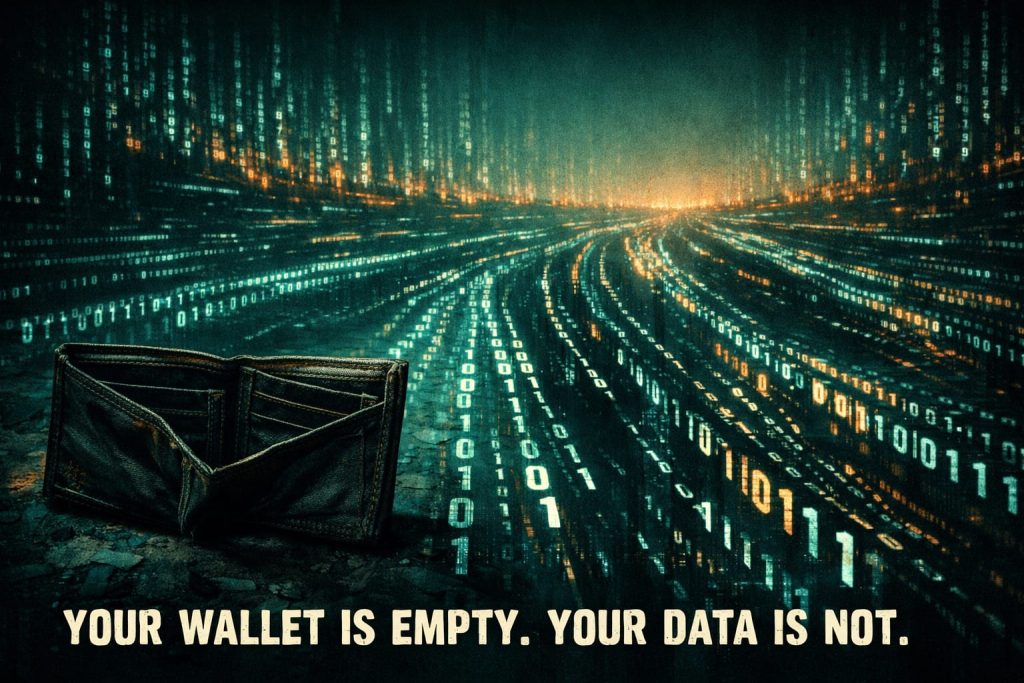
Financial privacy is vanishing. Not through a single dramatic decision, but quietly, through infrastructure. Here is what is actually happening, and why it matters to everyone.
A Perfectly Ordinary Purchase
Picture a member of a bank’s board of directors. Or a priest. Or a psychiatrist who treats other people for depression but attends therapy herself. They buy wine, sex toys, erotic literature, antidepressants. All of it completely legal. All of it paid for with their own money. They are not ashamed. They simply want these purchases to be their own business.
Until recently, cash guaranteed exactly that. Soon it won’t.
This is not a story about criminals or extremists. It is a story about the quiet disappearance of something most people take for granted, the ability to make a legal purchase without anyone keeping a permanent record of it.
What Cash Actually Is
Cash is not simply an old-fashioned way to pay. It is something more fundamental.
It is the only financial transaction in which an adult can legally buy something without a third party keeping a log. No bank. No government agency. No advertiser. No employer.
Every other payment method creates a record. Debit cards, credit cards, mobile payments, bank transfers, all of them leave a trail that persists, can be analysed, shared, sold, or handed over to authorities.
Cash leaves no such trail. That is not a design flaw. It is the whole point.
Researchers studying how people feel about money and privacy have found that anonymity, meaning the ability to pay without being identified, is consistently one of the features people value most in any payment system, including future digital ones. (Borgonovo et al., Journal of Financial Stability, 2021)
The American Civil Liberties Union, commenting on proposed US government digital currency design, stated plainly that money should be private and permissionless, just as physical cash has always been, with no middleman tracking every transaction or blocking those it finds inconvenient. (ACLU letter to the Federal Reserve, 2022)
The Disappearance Happens Without a Vote
Nobody has decided that cash will end. It is simply ending.
ATM networks thin out year by year. Merchants stop accepting cash, first voluntarily, then because removing cashiers makes it physically impractical. Legislation in many countries caps the maximum size of a cash payment. Banks close branches. The physical infrastructure of cash quietly retreats.
Finland is among the world’s most cashless societies. The shift took roughly two decades. There was no referendum. There was no serious public debate about what was being lost in the process. The change arrived through infrastructure, not through any law that said cash is abolished.
That is how it works. Infrastructure is more effective than legislation, because it does not require a vote.
Academic researchers examining this from a civil liberties perspective have been consistent in their findings. A cashless society concentrates extraordinary power in financial institutions, removes the only payment option that exists outside the banking system, and makes every economic act visible to parties whose interests may not align with yours. (Prpić, “Privacy, Identity, and the Perils of the Cashless Society”)
Crypto: Let’s Clear Up the Confusion
Before going any further, we need to address the assumption that stops most people from engaging with this topic.
“Isn’t crypto just for money laundering and criminals?”
The short answer is no, no more than cash or banks are. But the details matter, so let’s go through them.
What is a blockchain, in plain language?
A blockchain is a shared digital record book that nobody controls and everybody can read. When you send Bitcoin to someone, that transaction is written permanently into this record, visible to anyone in the world who wants to look. This is why Bitcoin is the opposite of anonymous.
Every single Bitcoin transaction ever made is permanently public. There is an entire commercial industry, with companies like Chainalysis and Elliptic among the best known, that sells software to police forces and tax authorities specifically for tracing Bitcoin transactions. It works well. Investigators have successfully traced and seized Bitcoin worth hundreds of millions of dollars.
A useful analogy is that imagine every banknote had its complete travel history printed on it in ink visible to anyone, recording every wallet it had ever been in and every transaction it had ever been part of. That is closer to how Bitcoin actually works than the dark money image it carries in the press.
So where does Monero fit in?
Monero is a different kind of cryptocurrency. It was built from the ground up so that transactions cannot be traced. Not by governments, not by companies, not by anyone. It hides the sender, the recipient, and the amount, by default, for every single transaction. This is achieved through advanced cryptographic techniques. The technical details are complex, but the outcome is simple: genuine financial privacy.
Most cryptocurrency use involves Bitcoin and similar traceable coins. Monero is a small but significant exception, significant precisely because it actually works as private money.
And the criminal use argument?
The largest money laundering operations in history ran through ordinary banks, not through Monero. Bitcoin, which is fully traceable, is used for far more criminal activity in absolute terms simply because it has far more users. The question of whether a tool can be misused is different from the question of whether it should exist at all. Cash can be misused. Telephones can be misused. The printing press was used to spread propaganda. That has never been considered a sufficient argument for abolishing any of them.
Monero, What Happens When Someone Builds Private Money
Monero is the clearest available test case for what happens when genuinely private financial technology exists in the world.
The protocol itself cannot be banned. It is open-source code, meaning the programming instructions are publicly available for anyone to read, copy, and run, and it operates on a decentralised network of computers around the world. There is no single server to shut down, no single company to prosecute out of existence.
But its infrastructure can be strangled. And it has been.
In 2025 alone, 73 cryptocurrency exchanges removed Monero from their platforms, including Binance, Coinbase, Kraken, and Bitstamp. (CCN, February 2026) The EU’s new Anti-Money Laundering Regulation will ban privacy coins entirely from July 2027. (CoinGeek, September 2025) Japan and South Korea banned it from licensed exchanges in 2021. India added it to the prohibited list in January 2026.
The technology works. The infrastructure around it is being systematically removed.
There is a distinction worth sitting with here. Regulators are not banning Monero because it is primarily used by criminals. Bitcoin is used by criminals at far greater scale, and Bitcoin remains perfectly legal everywhere. Monero is being restricted because it cannot be monitored. What is being eliminated is not crime. It is the possibility of privacy.
The Banking System as a Political Tool
To understand why the disappearance of private payment options matters, it helps to look at a documented case of what happens when those options are absent.
Between 2013 and 2017, the United States government ran a programme called Operation Choke Point. The Department of Justice and federal banking regulators quietly pressured banks to close the accounts of businesses the administration considered politically undesirable. They did this not through any law and not through court orders, but through informal guidance and regulatory pressure applied in private. The businesses targeted were entirely legal. They included firearms dealers, short-term lenders, and adult entertainment companies.
No legislation was passed. No court found these businesses to be breaking any law. Regulators simply classified certain industries as carrying what they called “reputational risk” to banks, and made clear in private conversations with bank examiners that serving such businesses would invite scrutiny. Banks found it easier to close the accounts. (US House Committee on Oversight and Government Reform, 2014)
The programme was eventually acknowledged and officially wound down. But many businesses were turned away by dozens of banks and could not recover their relationships even after it ended.
Then it happened again. Between roughly 2022 and 2024, the same mechanism was applied to the cryptocurrency industry. Observers called it Operation Choke Point 2.0. Informal regulatory pressure on banks to avoid all cryptocurrency businesses, regardless of their legal status or compliance record, produced the same results. Accounts were closed. Businesses lost access to basic financial services without any court finding of wrongdoing. (Davis Wright Tremaine, December 2024)
The lesson from both episodes is the same. When all financial transactions flow through monitored, regulated institutions, the ability to participate in economic life becomes conditional on political approval. No law needs to be passed. The infrastructure is sufficient.
What the EU Is Actually Building
The EU is developing two major digital infrastructure projects that are frequently confused with each other, and confused in their implications for privacy.
The EU Digital Identity Wallet
Every EU member state must offer citizens a digital identity wallet by the end of 2026. (European Commission) Think of it as a secure app on your phone that stores official documents, such as your driving licence, diplomas, and health records, and lets you prove things about yourself online and offline.
One genuinely useful privacy feature is selective disclosure. Rather than showing your full passport to prove you are over 18, you can prove your age without revealing your exact birth date or any other personal information. This is a real improvement over current practice in many digital services.
But it is important to be clear about what this wallet is not. The system knows who you are. It is an identity tool, not an anonymous payment instrument.
The Digital Euro
The European Central Bank is developing a digital euro, a form of money issued directly by the central bank rather than by a commercial bank. It is likely to become available to the public around 2028 or 2029, once legislation and technical preparation are complete. (FinTech Observe, 2026)
The project has been discussed using privacy language, and the ECB has engaged seriously with the question of how to design it. Some proposals involve offline payments that would function more like physical cash, without requiring a live internet connection and with limited traceability for small amounts.
But there is a fundamental tension that no amount of careful design language resolves. The same EU that bans Monero in 2027 cannot simultaneously create its own genuinely anonymous currency. The regulatory framework that prohibits privacy-preserving financial technology and the political goal of building a privacy-respecting digital currency are pulling in opposite directions.
What is on offer is pseudonymity. The merchant may not see your name, but the system keeps a record. The distinction matters. Anonymity means no record exists. Pseudonymity means the record exists but is currently protected, by present law, under present data protection rules, subject to the continued goodwill of whoever holds the data. One guarantee is mathematical. The other is political.
(ScienceDirect, on tokenisation and anonymity in CBDC design, 2025)
Why This Affects You Even If You Do Nothing Wrong
There is a standard response to concerns about financial surveillance: if you have nothing to hide, you have nothing to fear.
This argument has a structural problem. It assumes that what counts as something to hide is fixed, neutral, and determined by people whose interests align perfectly with yours. None of those assumptions hold for long.
What is legal today can be restricted tomorrow. What is unremarkable in one political climate becomes significant in another. The person who donated to a particular cause, bought books on a certain subject, or visited a specific type of doctor, might find that history used against them in circumstances they could not have anticipated.
Researchers studying surveillance have documented what they call the chilling effect: people change their behaviour when they know they are being observed, even when their actions are entirely legal. The knowledge of observation changes what people buy, what they read, and what organisations they choose to support.
Payment data is the most detailed record of a human life ever created at scale. More detailed than anything you would write in a diary. It records what you eat, what you read, where you go, who you spend time with, when you are sick, when you are anxious, and how your relationships change over time. This data can be stolen in a security breach, sold by a company that changes its business model, subpoenaed by a government, or acquired by a foreign intelligence service. What does not exist cannot be leaked.
There is also a dimension that rarely enters these debates. Cash is the only payment instrument that works without a bank account, a credit score, or a smartphone. Its disappearance falls hardest on those already most vulnerable: elderly people who find digital systems difficult, people without stable addresses, those with debt problems that prevent them from holding accounts, and people in abusive relationships where a partner monitors their spending. A cashless society is not equally cashless for everyone.
(Cash Essentials, on cash and economic autonomy)
A Historical Observation, Without Conspiracy
This does not need to be overstated. One observation is enough.
Across different political systems and different centuries, one pattern recurs. Those who seek to control populations find that controlling money is among the most effective tools available. Not always as the first step, and not always dramatically, but consistently, financial control has been part of the toolkit of authoritarian governance.
A digital currency with no anonymity makes this capability available without requiring any additional surveillance infrastructure to be constructed. It arrives as a feature of the payment system itself.
This is not a prediction. It is a design observation. The question is not whether today’s governments will misuse this capability. Most probably won’t, most of the time. The question is whether it is wise to build infrastructure without protections, on the assumption that it will always be governed by people with good intentions.
Locks on doors were not invented because most guests are thieves.
Nobody Asked You
When were you last consulted about whether you wanted to give this up?
Not in a referendum. Not meaningfully in any election, where this has never been a central issue. Not in a public debate that reached beyond specialist policy circles.
The disappearance of anonymous payment as an option is one of the most significant shifts in everyday financial privacy in living memory. It is happening through the slow withdrawal of ATMs, the quiet delisting of privacy-preserving technologies, and the gradual removal of infrastructure that made private transactions possible.
Perhaps that is acceptable. Perhaps the convenience and security of digital payments are worth the trade. Perhaps the privacy protections built into digital systems will prove robust and lasting. These are reasonable positions that reasonable people hold.
But they should be positions you choose, not circumstances that simply arrive while you are looking elsewhere.
Sources are linked throughout this article. For a comprehensive technical survey of privacy-preserving digital payment systems and their regulatory context, see: arxiv.org/html/2505.21008v3