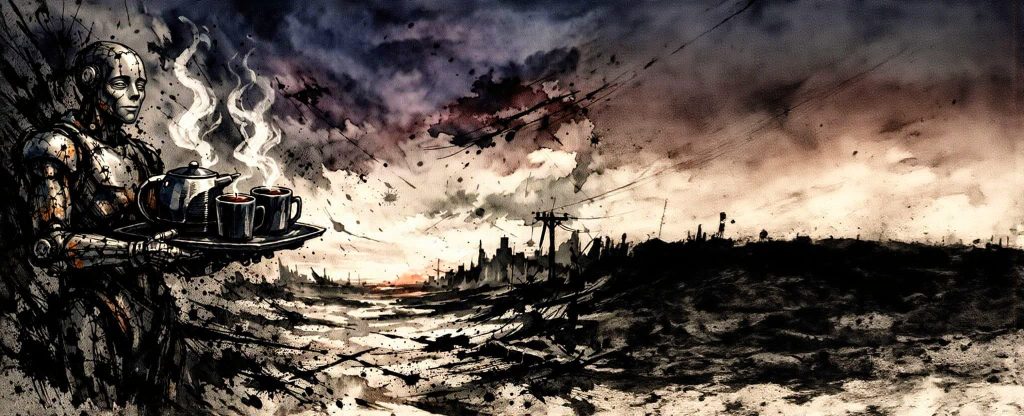
The Friction of Creation and Art Beyond the Product
What qualifies as art? We often limit the definition to something framed on a wall, but art is a sensory encounter that is heard, touched, and felt as much as it is seen. It is a subjective friction point between the creator and the experiencer.
A clear divide exists in the reasoning behind art. On one side, there is commercially calculated work created with a specific market, price point, or trend in mind. This serves a purpose but often lacks the raw pulse of discovery. On the other side is the art of the journey. For me, the process is the primary reason for existence. The struggle with the medium, the shifts in direction, and the mental immersion are where the meaning lives. A successful end result is a rewarding bonus, but if the journey is hollow, the outcome rarely carries weight.
However, recognizing art as a personal journey should not lead to the devaluation of artistic labor. A common and unfortunate misconception is that because artists are driven by an internal fire, they should create for free. We often hear people question why an art experience carries a price tag, assuming the creator would be “daubing” or “scribbling” regardless of payment. This is a fallacy. Professional artistry requires time, skill, and resources; like any other profession, it warrants fair compensation. The passion of the creator is not a subsidy for the consumer, and the work produced is no less of a professional service simply because it stems from a calling.
If we look at children, we see that everyone starts as an artist. They create with a natural and uninhibited fire, indifferent to commercial value or correct technique. Usually, this fire is buried under the weight of self-consciousness and the adult need for utility. We stop playing because we start fearing the pointless journey. Reclaiming that fire means accepting that art does not have to be a product for a buyer to have spiritual value, but it must be respected as professional labor to have a place in society.
The Boundaries of the Sacred and the Profane
If we accept that art is a journey, we must ask where the map ends. Is a television commercial art? It employs the tools of the trade like rhythm, visual storytelling, and emotional manipulation, but its soul is tethered to a transaction. Art exists for itself while a commercial exists for the product. When the goal is strictly to sell, the journey is compromised by the destination.
Yet art is everywhere if we choose to perceive it. It is in the calculated silence of a performance piece and the fleeting patterns of a sand mandala destined to be swept away by the wind. These ephemeral forms include things like improvisation theatre or stand-up comedy, and they underscore the idea that the result is often an illusion. Stand-up is one of the purest forms of performance art where the comedian uses rhythm and raw truth to trigger an emotional release. Laughter serves as a form of catharsis.
Similarly, political satire acts as a weapon by shifting the cultural feeling and making the invisible visible through irony and exaggeration. Once the sound fades or the sand is scattered, nothing remains but the transformation within the experiencer.
This boundary is most contested on the screens that dominate our lives. In the past, children’s programming like Teletubbies functioned as a form of surrealism, using slow rhythms and dream-like imagery calibrated for the developing biological system of a toddler’s brain. It offered a sensory encounter rather than just facts. Today, that environment has been overtaken by a frantic, high-velocity pulse of fragmented, algorithmic media (such as TikTok or Reels). Unlike the intentional surrealism of the past, these platforms often represent the ultimate expression of art-as-transaction, engineered to exploit dopamine loops rather than invite reflection.
Even within this digital chaos, educational content can rise to the level of art. Series like the classic animation Once Upon a Time… Man and its spin-offs are a testament to this. They do not just transmit information. Instead, they use metaphor, recurring characters, and narrative rhythm to build a human bridge between history and understanding. If the act of teaching uses the tools of drama to change how the experiencer sees the world, the instruction itself becomes a performance. The educational goal is the destination, but the art is the transformation that happens during the lesson.
Catharsis and the Biological Mind
Why do we seek out art that leaves us unsettled? Aristotle spoke of catharsis as a spiritual cleansing through the experience of pity and fear. When we engage with art, we are undergoing an emotional release rather than just observing. This is the moment where the journey of the creator meets the internal landscape of the experiencer.
But what happens when the creator is not human? This brings us to the most polarizing frontier of our time, Artificial Intelligence. To understand this, we must confront the nature of our own existence as complex biological organisms. While some view the human body as a biological machine, we are far more than digital processors. The brain is a living organ, driven by a seamless integration of chemistry and environment that goes far beyond the isolated electrical signaling of a neural network.
Our inspiration is an organic cocktail of neurochemicals and embodied experiences. If an AI melody triggers a genuine catharsis, does the source matter? While AI can mimic the style of a child or the stroke of a master, it operates by mathematical optimization rather than by the human need to “glitch” the system. It can simulate the result, but it cannot yet experience the exhausting, messy, and often painful journey of discovery that defines the human artist.
The Art of Unlearning and Picasso’s Radical Return
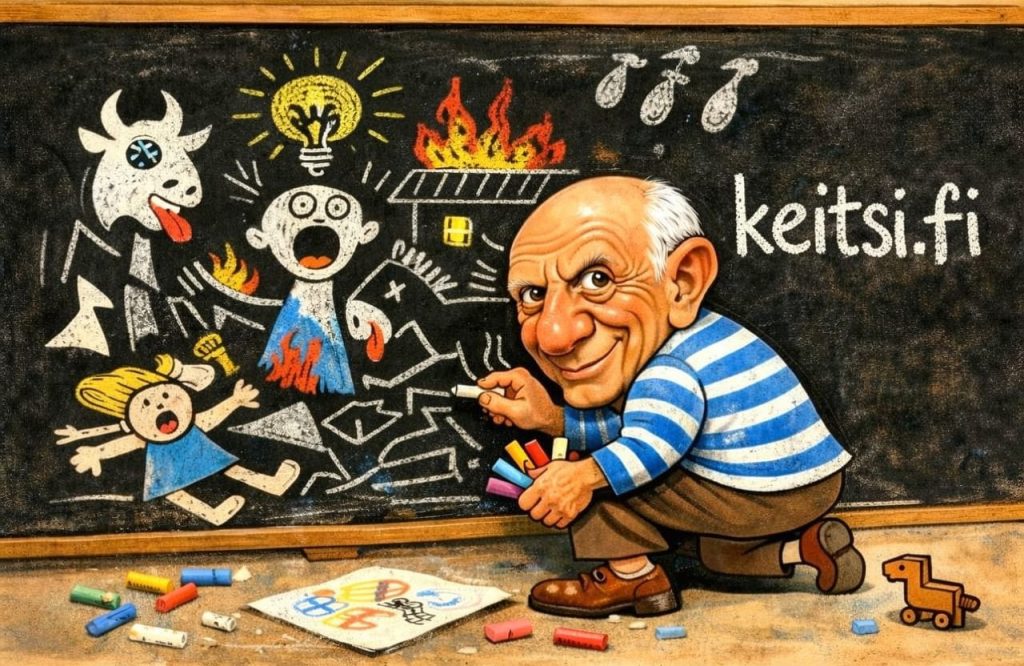
Pablo Picasso’s life is the ultimate testament to this struggle. He possessed technical mastery as a teenager and was capable of painting like the old masters before he was twenty. Yet he spent the rest of his life stripping that skill away. He famously said it took him four years to paint like Raphael but a lifetime to paint like a child.
This was a radical unlearning and an intentional effort to bypass his own mastery to find a more honest way to see the world. He was searching for that raw and uninhibited fire that we all possess as children before the world tells us to be productive, correct, or profitable. This is the core of the creative spirit which is the ability to see the world for the first time, every time.
Whether it is a master’s final abstract struggle, a political satirist’s biting truth, or the surreal patterns of a toddler’s program, the distinction lies in the intention of the journey and the depth of the resonance. Art remains our most profound way of navigating what it means to be human. In a world of infinite content, art is the necessary act of breaking the cycle of utility to find something that is purely, beautifully, and pointlessly human.
Sources for Further Exploration
Stanford Encyclopedia of Philosophy – The Definition of Art
This entry provides a rigorous academic overview of the historical and contemporary attempts to define art, exploring why the task remains one of philosophy’s most enduring challenges.
The Art Story – Performance Art and the Ephemeral
This resource examines art forms that exist primarily as actions and experiences rather than physical objects, focusing on the significance of the moment and the rejection of art as a commodity.
InfoQ – The Brain Is Not a Computer
An exploration of the biological mind and why treating the brain as an isolated digital processor ignores the essential role of the body and environment in human consciousness.
The Metropolitan Museum of Art – Picasso and the Myth of the Child
An exploration of Picasso’s conscious decision to dismantle his technical mastery in favor of a simpler, more direct way of seeing, mirroring the uninhibited creativity of childhood.
Britannica – The Concept of Catharsis in Art and Drama
A study of the Aristotelian concept of catharsis, explaining how art serves as a medium for emotional purification and spiritual release for the observer.
Oxford Academic – Mass AI-art: A Moderately Skeptical Perspective
A philosophical defense of the idea that art requires intentional control—a quality that AI-generated “mass art” often lacks compared to human-driven works.
Sir Ken Robinson – Do schools kill creativity?
This record-breaking TED Talk explores how standardized education systems prioritize academic ability over creativity, potentially stifling the natural imaginative capacity of children as they grow into adulthood.
Every image on this site is copyrighted. Save yourself the trouble and ask before using anything.