There’s a persistent myth about artists and control. The artist has a vision. The artist executes the vision. The vision becomes the work. Clean, heroic, deeply photogenic.
That is not quite what happens here.
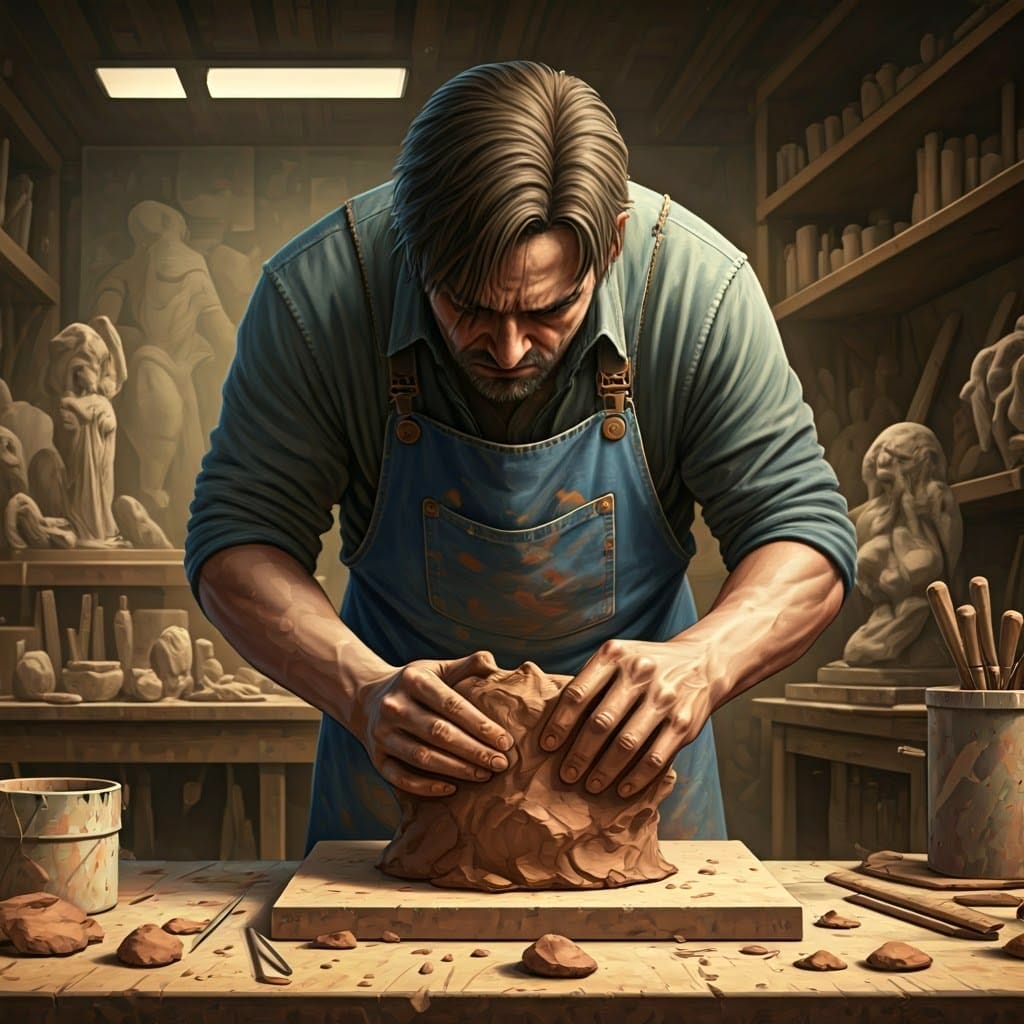
When I work with clay, the clay is not waiting passively for instructions. It has its own ideas, its own structural logic, its own quietly insistent sense of where things should go. I arrive with a plan, somewhere between a sketch and an educated guess, and the clay proceeds to redirect the entire meeting. A wall leans where it shouldn’t. A surface develops a texture that wasn’t in the brief but turns out to be the whole point. By the time something is finished, it looks considerably less like my original idea and considerably more like a negotiation I only partially won. I’ve made peace with this. Arguing with clay is both exhausting and philosophically embarrassing.
What I’ve also made peace with is that the destination was never really the point. The interesting part is the journey, what happens between the first mark and the last, the unexpected turns, the moments when something pulls you sideways and you follow it somewhere you didn’t plan to go. The finished object is evidence that a journey took place.
What surprises people is that the same dynamic appears in my AI-generated work. They expect it to be the opposite, the artist as supreme commander, the algorithm as obedient intern. It isn’t. The model has its own gravitational pulls, its own strange preferences, its own occasional flashes of producing something you didn’t ask for that turns out to be exactly right. You set off in one direction and arrive somewhere adjacent, somewhere slightly unexpected, sometimes somewhere better. The process of getting there, the iterations, the detours, the gradual convergence on something that finally feels right, is where the actual work happens. The image at the end is a postcard from the trip.
The perfectionism doesn’t help, of course. Why settle for good when excellent is technically still possible? This is a question I ask myself at unhealthy intervals, in both directions. It is a well-documented artistic affliction and I have it badly.
The key difference between the two is significant and brutal. Clay doesn’t have an undo button. If I overwork a piece, and I have, reliably, with enthusiasm, that’s it. The previous version exists only as a memory and a vague sense of loss. Every decision is in the object, including the ones you’d rather take back. There’s something clarifying about that irreversibility. Also, occasionally, something heartbreaking.
With digital work, earlier versions wait patiently in case you need them. This sounds like pure advantage and mostly it is, except that it removes a pressure that turns out to be useful. Irreversibility forces presence. When you cannot go back, you pay closer attention to now.
This is entirely subjective, I should mention. Some artists do have clear visions and execute them precisely. Some people also enjoy running marathons. I’m not here to judge.
John Dewey argued in 1934 that the actual work of art isn’t the finished object. It’s the experience of making it. The process, the unexpected turns, the moment when something shifts and you follow it somewhere unplanned. The physical piece is just evidence that something happened. Roland Barthes, whose essays I first encountered studying Finnish literature in University of Helsinki in the early nineties, had already questioned whether the author is really in control of meaning at all, which reads less like literary theory and more like field notes when you’re watching clay override your intentions in real time.
Neither of them was thinking about AI. But they might as well have been.
I make sculptures from wire mesh, concrete, ceramics, and whatever else seems willing. I generate images through algorithms, paint the occasional abstract, write song lyrics, and treat cooking as a daily form of applied aesthetics. Photography has been part of the mix for decades, and more recently video art has started pulling at my attention with the particular cruelty of something that is both genuinely compelling and genuinely labour-intensive. Several novel openings are patiently ageing on hard drives, waiting for either discipline or recklessness to win.
The tools are completely different. The process, the negotiating, the following, the stubborn pursuit of something slightly better than what currently exists, is recognisably the same across all of them.
The medium changes. The conversation doesn’t.
Further reading, for the philosophically inclined:
John Dewey, Art as Experience (1934) — free at Internet Archive
Roland Barthes, “The Death of the Author” (1967) — Wikipedia overview, widely available in essay collections
Anton Ehrenzweig, The Hidden Order of Art (1967) — on the unconscious logic of the creative process; not digitised but widely available in libraries and secondhand
Andy Hamilton, “The Art of Improvisation and the Aesthetics of Imperfection”, British Journal of Aesthetics 40:1 (2000) — abstract via Oxford Academic
Sungjin Park, “The Work of Art in the Age of Generative AI: Aura, Liberation, and Democratization”, AI & Society 40 (2025) — abstract via PhilPapers
Wabi-sabi and the aesthetics of imperfection — Stanford Encyclopedia of Philosophy, Japanese Aesthetics
Dewey’s aesthetics in depth — Stanford Encyclopedia of Philosophy, Dewey’s Aesthetics